Maths
Intent
Maths at Dorothy Barley Junior Academy is informed by the philosophy and pedagogy of the White Rose Maths Hub. This approach has been influenced and shaped by leading maths researchers and practitioners from across the world.
Our aim is to develop a culture of deep understanding, confidence and competence in mathematics. Through this, we promote strong, secure learning and meaningful progress for all pupils. We also provide additional support through gap-filling sessions, focused times tables practice, and cross-curricular opportunities where appropriate.
To support and deepen pupils’ learning, we use White Rose Maths workbooks alongside high-quality teaching. These workbooks help children to develop conceptual understanding, build fluency and apply their knowledge through carefully structured practice and problem-solving.
At DBJA, we:
Deliver a high-quality maths curriculum that is both challenging and enjoyable.
Enable children to make rich connections across mathematical ideas, developing fluency, reasoning, and the ability to solve increasingly sophisticated problems.
Encourage pupils to apply their mathematical knowledge across the wider curriculum.
Promote the importance of maths in everyday life, helping children to become confident mathematicians who are willing to take risks and learn from mistakes.
Foster independent learners with inquisitive minds, secure mathematical foundations and a drive for self-improvement.
Mathletics is used to support home learning. The White Rose One Minute Maths app is also recommended to support times tables practice and is free to download.
Maths at Dorothy Barley Junior Academy is informed by the philosophy and pedagogy of the White Rose Maths Hub. This approach has been influenced and shaped by leading maths researchers and practitioners from across the world.
Our aim is to develop a culture of deep understanding, confidence and competence in mathematics. Through this, we promote strong, secure learning and meaningful progress for all pupils. We also provide additional support through gap-filling sessions, focused times tables practice, and cross-curricular opportunities where appropriate.
To support and deepen pupils’ learning, we use White Rose Maths workbooks alongside high-quality teaching. These workbooks help children to develop conceptual understanding, build fluency and apply their knowledge through carefully structured practice and problem-solving.
At DBJA, we:
- Deliver a high-quality maths curriculum that is both challenging and enjoyable.
- Enable children to make rich connections across mathematical ideas, developing fluency, reasoning, and the ability to solve increasingly sophisticated problems.
- Encourage pupils to apply their mathematical knowledge across the wider curriculum.
- Promote the importance of maths in everyday life, helping children to become confident mathematicians who are willing to take risks and learn from mistakes.
- Foster independent learners with inquisitive minds, secure mathematical foundations and a drive for self-improvement.
Mathletics is used to support home learning. The White Rose One Minute Maths app is also recommended to support times tables practice and is free to download.
Maths Curriculum Review
Our Maths curriculum review has focused very much on securing foundational knowledge and skills through a whole school approach. It has not been about simply providing intervention for lower attaining (Targeted Support children) but more about increasingly building the foundations of maths into curriculum design, teaching, assessment, CPD and SEND provision, with a strong emphasis on fluency, essential facts, assessment, curriculum prioritisation, representations and improving staff subject knowledge.
Summary of what we are doing to secure stronger outcomes in Maths
- Made foundational mathematical knowledge a whole-school priority
We are acutely aware that end of key stage results are not strong enough in Maths and therefore FKS is explicitly embedded within the 2026–27 School Development Plan. The expectation is that teachers accurately assess children’s foundational knowledge, identify gaps and adapt the curriculum so that our children can make sustained progress. Maths has additional actions around subject knowledge, monitoring, data analysis and “keep-up” intervention. - Identified the essential facts pupils need to know
Our September Maths INSETs specifically focused on foundational facts, including identifying essential facts and strengthening the foundational knowledge our children need for later mathematics. To support this, our 2026–27 materials identify these essential facts more explicitly. - Strengthened connections between known facts
Our revised approach explicitly teaches children to use a known fact to derive another, for example: if I know 3 × 4, I can use this to know 30 × 4. This moves the focus beyond recalling isolated facts towards applying foundational knowledge. - Added previously under-emphasised essential skills
Our revised foundational knowledge materials specifically add bridging through 10 as an essential skill. They also place greater emphasis on our children applying multiplication knowledge, rather than only recalling multiplication facts. We know we do well in MTC tests but know that children struggle to apply these skills in subsequent units of work and in reasoning and problem-solving tasks. - Strengthened mathematical fluency
Our SDP identifies the continuation of FKS, including fluency, as a specific priority. Staff training to support fluency in mathematics and the development of fluency/FKS tracking systems have been explicitly planned within this work. - Developed more systematic assessment and tracking of FKS
We have established a more robust FKS tracking process which includes online tracking so that those planning maths and school leaders can identify and provide the right support for underdeveloped skills. Our SDP requires accurate baselines and more frequent analysis of maths data by senior leaders, including FKS assessments and tracking, so that findings inform action at school, cohort and class level. - Adapted curriculum sequencing in response to pupils’ starting points
Curriculum prioritisation and alternation have been explicitly explored. We have focused on how teachers split small steps, provide further practice to embed understanding and balance fluency with reasoning and problem-solving. - Strengthened explicit modelling and lesson structure
Our Maths INSETs have also included refocusing on our shared lesson structure and the**”I do, We do, You do”** progression. During guided practice, teachers assess understanding and can move children on when they are ready, while using questioning to revisit the foundational knowledge children need. Staff Maths Bitesize CPD sessions have included live modelling demonstrations to increase staff confidence in modelling metacognitive strategies. - Increased the use of representations and concrete resources
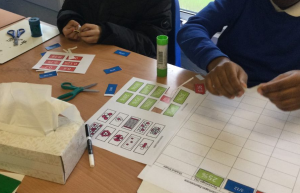
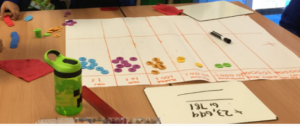
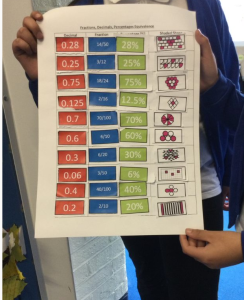
Our SDP specifically identifies CPA and our new White Rose class packs alongside other manipulatives as resources supporting this priority and we have purchased manipulatives to support our children’s independence and understanding of key mathematical concepts. - Strengthened consistent mathematical vocabulary
Staff training has explicitly addressed consistency in mathematical definitions, with child-friendly vocabulary definitions organised into mathematical domains and aligned to long-term curriculum overviews. This vocabulary is then be reinforced through teaching flips and our working walls. - Ensured FKS does not mean lowering expectations
Our work has also considered children who grasp concepts rapidly. Reasoning and deepening opportunities are designed to allow these children to move beyond fluency into greater challenge, while scaffolded examples and sentence stems support lower-attaining (Targeted Support) pupils to engage with reasoning. - Increased reasoning and problem-solving alongside fluency
Maths expectations include whole-class access to reasoning and problem-solving, revisiting misconceptions and mathematical vocabulary. Staff CPD has also introduced REAch2 Reasoning and Deepening approaches that can be applied across content domains and at different points within lessons. - Strengthened staff subject knowledge and professional development
Maths subject knowledge is a specific leadership priority. The SDP includes targeted maths training, collaborative planning, coaching, team teaching and lesson study, with school leaders expected to model effective practice and support colleagues. - Increased monitoring and external support
Our SDP sets out greater leadership scrutiny of maths through joint monitoring, analysis of FKS assessments and increased CPD. More recently, following a maths learning walk and book look, an external adviser recommended additional planning support, including CPD and planning support for year groups. The impact of this will be assessed through our monitoring and evaluation cycle. - Introduced additional support where pupils need to catch up
The SDP explicitly references maths intervention/pre-teaching models, earlier MTC and Year 6 boosters, and actions around intervention for children needing to keep up. Where there are issues in specific classes or cohorts in maths, intervention is being used to allow children to secure better foundational knowledge.
In summary
We have identified that gaps in foundational mathematical knowledge were preventing some pupils from accessing age-related learning securely and applying their knowledge independently. In response, we have sharpened our focus on the essential knowledge and facts pupils need to become fluent mathematicians. This includes greater emphasis on essential number facts, bridging through 10, multiplication knowledge and making connections between known and derived facts. We have strengthened assessment and tracking of FKS so that gaps can be identified promptly and used to inform curriculum prioritisation, teaching and intervention.
Teaching has been strengthened through a clearer lesson structure, explicit modelling, guided practice, mathematical vocabulary and appropriate use of representations and manipulatives. Alongside fluency, we have maintained high expectations for reasoning and problem-solving, including deeper challenge for pupils who grasp concepts rapidly and scaffolding to enable lower-attaining (Targeted Support/Age Related Support) children to participate successfully.
This has been supported by a stronger programme of subject-specific CPD, collaborative planning, monitoring and external support. Leaders have increased scrutiny of maths through FKS assessments, data analysis, pupil voice, book looks and lesson monitoring, with findings feeding directly into teaching, intervention and professional development.
Maths Overviews by Year Group:
R2 White Rose Y3 Long Term plan Scheme 3.0 (2)
R2 White Rose Y4 Long Term plan Scheme 3.0 (1)
R2 White Rose Y5 Long Term plan Scheme 3.0 (1) (1)
R2 White Rose Y6 Long Term plan Scheme 3.0 (1)
Maths Calculation Policies by year group:
Calculation policy 2024 Year 3
WRM calculation policy 2024 Year 4
WRM calculation policy 2024 Year 5
WRM calculation policy 2024 Year 6
DBJA Times Tables Policy:
Maths Vocabulary Booklet:
Primary maths – Vocabulary progression
INFORMATION ABOUT THE YEAR 4 MULTIPLICATION TABLES TEST 2024:
Useful Websites:
https://www.mathletics.com/uk/
Recommended App:
https://whiteroseeducation.com/1-minute-maths
Manipulatives
We promote the use of manipulatives in Maths as a way of creating a solid foundation of Mathematical understanding.